Hey Cuz, Solarpunk Needs You!
Why Solarpunk needs more Black voices and visions

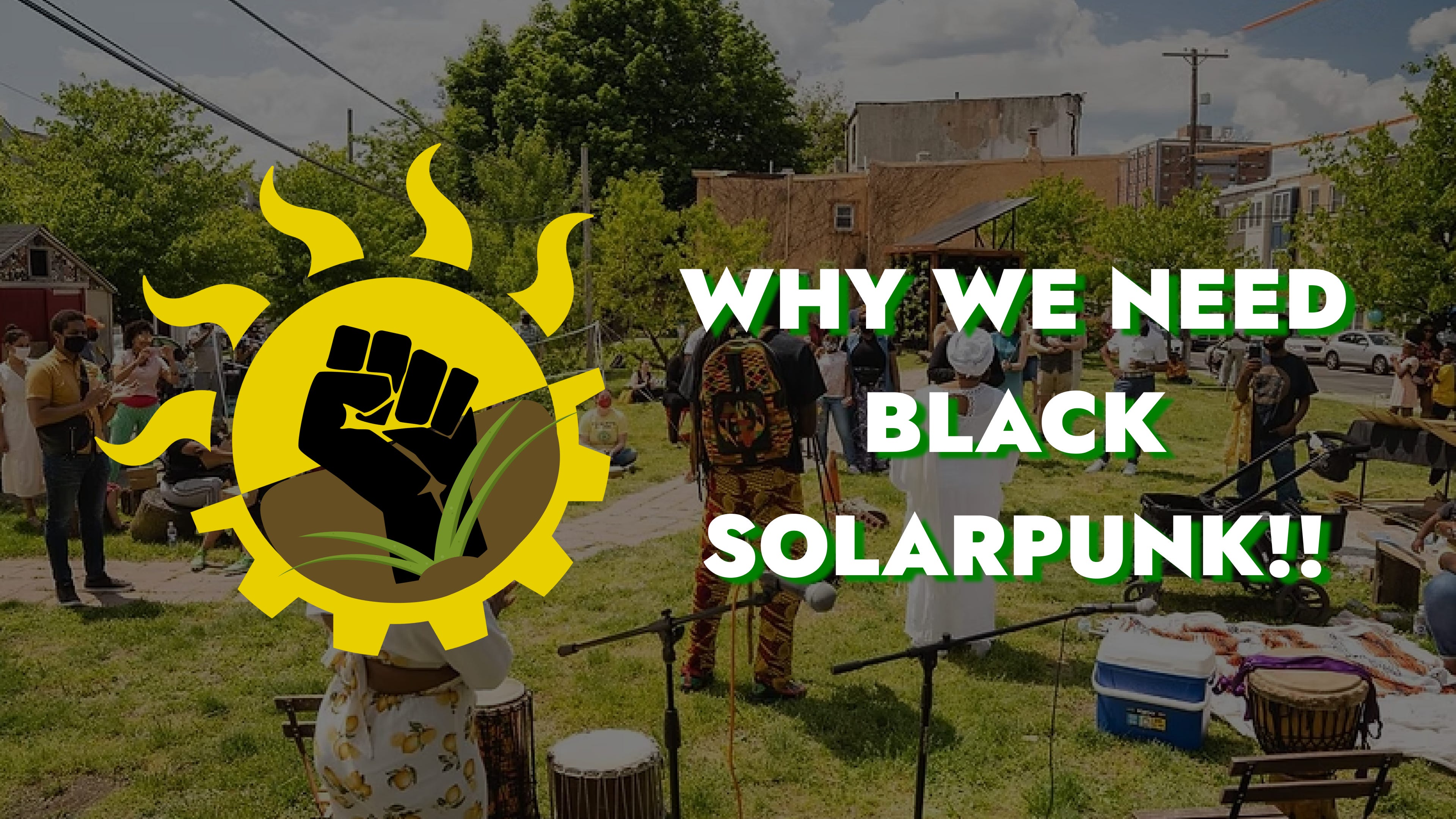
I’ve been a big fan of the solarpunk movement for years now. I forget when I first heard of it, but it was a bit before the (in)famous yogurt commercial that helped boost the idea. I happened to see the decommodified version first and was excited to see such a visually engaging depiction get so popular so quickly. Since then, I sought out solarpunk fiction and even real-world examples that I could do at home, or otherwise use as proof that this wasn’t just pretty aesthetics.
However, a big point of frustration has been:
seeing how many solarpunk stories feature little to no black people (and how few long form media there is either way).
how certain kinds of people are so quick to dismiss, bastardize, or separate the solar from the punk.
I think these are related.
In my community, folks are often intrigued when I introduce the idea to them, but it’s nonetheless a slight bit nerve-wracking that even the most radical people I know have no idea that what they’re doing IRL is the type of stuff others fantasize about.
Too often, media makes mythologies of praxis and underrepresents the role black people play in revolutionary change, or even renders them invisible due to an inherent misunderstanding or discomfort with racialization.
As someone who has always been a huge fan of scifi and fantasy, I’ve long since had to deal with the lack of representation in the media. Even when there is representation, its often token-ish and/or divorced from black culture, especially the black radical struggle.
I’ve been able to find some great inclusive media in the past few years, largely thanks to afrofuturism and black girl magic, but there is something unique about solarpunk, specifically, that I REALLY want more black folk to be able to participate in.
Unlike any other genre of media, Solarpunk is uniquely unafraid to imagine better futures…. dare I say utopias. Most every other genre of fiction has some sort of dystopian element to it, or at the very least just a transfer of modern day problems into a fantasy or scifi world. I hate that! Because that means even in the space of our imaginations, where anything can happen, the vast majority of people cannot imagine what life could be like if things were legitimately better…. If we didn’t have to worry about some form of racism, sexism, classism, queerphobia, poverty, war or other form of authoritarianism. I guarantee you even people who just read that line will be like ‘Yeah of course… thats just human nature’. Smdh. And that is the problem.
If we can’t even imagine humans being better to each other… then of course we will never build a truly better society.
Where would we be if Harriet Tubman and Toussaint Louverture and other enslaved folks could not imagine themselves outside of slavery? If MLK Jr. did not have a dream? If the Black Panthers just wanted to be the black KKK instead of Black revolutionaries championing peace and love?
We need to be able to envision radically better futures if we ever hope to actually solve these problems we’re dealing with today, rather than constantly repeat the same damn mistakes generation after generation. If you truly believe its just ‘human nature’ to be greedy, selfish, hateful, and otherwise apathetic to the world around you…and that we can’t do anything about it, then of course you’ll never fight to build a better world! It is precisely that lack of imagination that leads people to believe that the best they can do is just to game the system or be the one at the table, instead of mulching the table and feeding everyone, everywhere.
And as much as I love superhero stories, isekai, litrpgs, progression fantasies, space operas, and so on… If the most hopeful stories we create and consume are about individuals being individually strong, smart, powerful, or otherwise personally overcoming great odds to ‘save the world’… but the world itself never actually changes, then what really is the lesson? What’s there to hope for besides being a ‘good’ person in a fucked up world?
We have to want more not just from ourselves as individuals, but from all of us as a society.
Solarpunk and its related genres (like hopepunk, cozy fiction, and even some climate fiction) are daring to dream beyond today’s problems. They are imagining worlds that have figured out how to actually (try to) win the fights we’ve been fighting for generations. They still have conflict that feels realistic, both as storytelling tools and as a part of the world they’ve built… but those conflicts are either exceptions rather than the norm, or simply just better problems to have! Creative conflict, if you will, as opposed to the destructive or nihilistic conflicts we often face today. And if you’re wondering what that means, please check out my other writing, because that’s exactly what I have been exploring!
All that being said… all is not lost.
As I’ve been out in the world more, getting involved with orgs and initiatives I find compelling, I’ve been noticing how many people are essentially living a Solarpunk life without even realizing it.
Many people are deciding to do what they can to produce the things they consume locally and regeneratively, instead of depending completely on this inherently exploitive, destructive, and rapacious imperial capitalist system.
I’ve been especially focused on food production and construction because I believe its the key to helping people become self sufficient as anarchic communities largely independent of the state or corporations. If we can feed and house ourselves, we are infinitely closer to truly giving all the power to all the people.
Many of us inherently know the importance of self-sufficiency through communal solidarity. If you can produce your own food, or frequent a food distro, or just pool together with neighbors, then you wont need to go to the store as much, thus saving money and ensuring you have some measure of safety from economic hardship and fluctuations.
Beyond the desire to survive though, are those setting themselves up to thrive; people who are imagining what a better future could look like if they are able to live more in tune with the environment.
🌻 They aren’t just trying to be urban farmers with monocrops or live off-grid. They are trying their damndest to rediscover sustainable, regenerative indigenous practices of communal living.
And yes, many of these people happen to be black, or in community with us. Going forward I may use the term New Afrikan because I find it quite compelling, especially to go beyond race and colonial epithets. But either way, I have been ecstatic to see how many of us are out here just doing the damn thang.
This is not exclusive to black folks, obviously. This is not about ownership or trying to control anything. This is about participation and inclusion. Its me sharing how my personal experiences in the real world have beautifully colored my perception of Solarpunk media and its potential for real world change.
This is me trying to do my small part in remedying the lack of black culture in scifi (and fantasy) genres, even ones as radical as Solarpunk and hopepunk.
This is a call for black people, for New Afrikans, Pan-Afrikans and other folks across the diaspora to get into the Solarpunk space. To recognize our inherent power and history with imagining better futures for ourselves.
Afrofuturism is fantastic, but I want us to do more. To not constrain ourselves to just the one genre, and to ensure our afrofuturism is itself not just imagining ourselves at the capitalist/hegemonic table.
Let me show you what I mean.
—
In the last couple of weeks I’ve been to the Roots N Earth Family Farm which is doing all sorts of incredible work. In just 5 years since moving to Atlanta, they turned a typical yard you’d see here in the metro area into a burgeoning food forest. They’ve got water catchment systems and a tool library and so many awesome things! They’ve been teaching workshops around how to do natural earth builds like clay ovens and superadobe structures.
I’ve been to Project South: a mutual aid center growing a huge community garden, paying special attention to involving the youth and the elders. They also have a lot of space they lend out to all manner of local organizations to gather and discuss with the community. They even have a mini library and will be restarting their thrift store!
I’ve been to the home of a Green Clothe collective founder, who is turning their yard into a veritable permaculture garden. They discovered there was a lot of lead and other heavy metals in the soil from the lead paint that was used when the house was built back in the 60s. So we’re going to be doing land healing (ie Bio Remediation) workshops to both work on the land and teach/involve the community as we do it.
And a lot of this is thanks to working with Building Kujichagulia, which has a Black Land Bus project inspired by the Jessup Wagon, and was itself founded by the community’s desire to build a community kitchen instead of copcity.
But it’s not just here in Atlanta, I’ve been learning and getting inspired by:
North Philly Peace Park, who has been creating an urban center in the middle of an underserved neighborhood to serve the community with fresh food and communally built learning centers.
The Abolitionist Atlas, a sort of modern day Green Book mapping out various liberatory practices in the Black South.
Cooperation Jackson, an incredible and dedicated coalition building a solidarity economy in Mississippi. They regularly share their extensive knowledge through their Build And Fight Formula.
Indigenous Hawaiians rebuilding their ancient food forests
And of course the many international efforts like Kisiki Hai in Tanzania, to Chad’s lake project, to the overall Great Green Wall of Africa project, and countless more. (Please share what you know, since I’ve been hyperfocused on what’s local to me!)
These are just the modern day examples I’ve stumbled across.
I’ve also been learning a lot more about the rich history of black people refusing to be subjugated and fighting for true freedom from all oppression.
From the long history of the Gullah Geechee and maroons using knowledge of the land to win against the US government.
To the history of Afrikan people hiding seeds in their hair once they realized the scope of the transatlantic slave trade to ensure they would be able to eat even when they were taken.
To the Lakou system in Haiti and other family farm systems enslaved folks fostered across the Americas in order to feed and heal each other even amidst such horrifying conditions.
Natural remedies foraged and/or grown locally runs deep in the Black/New Afrikan culture. Not just done blindly either, but through a scientific process developed amidst stark oppression. Recall how your grandma always knew some tincture or natural remedy to help with sickness. Idk about you but my grandma had a whole herbalism textbook she used to read in addition to her ancestral knowledge.
All of this made me realize why I like Solarpunk so much. Not just because of the cool and hopeful aesthetics, and certainly not because of some ‘cottage core naivete’, but because of the very real, historical, and radically optimistic practice that my people have had for generations.
The Black radical struggle has always been one of optimism. Not based on some passive hope, but an active, diligent, and tenacious process of birthing a better future. With all the ups and downs, pains and joy that requires. It’s a refusal of despair. Being black is not a choice, being racialized was horrible, but the way black radicals have characterized blackness to be about solidarity, rebellion, and liberation despite all odds is exactly the type of optimism I am driven by. It’s that fierce hope that we can and will stop even the most pervasive of atrocities, if we fight with love and tenacity. By any means necessary.
Despite our racialization, we build community and true freedom. Despite facing poverty and eradication, we created something from nothing.
That refusal to accept injustice is exactly what is needed to create utopia. To create something radically better. To build better futures for the next generation.
Black folks across the diaspora have always been punk (literally helping to invent the movement). Have always fought oppression. As Huey P Newton showed, have always utilized the technology of the day to speak truth to power, to fight the power, and to give power to the people.
Above all, we have also always been stewards, children, and proponents of Mother Earth.
This reality has really been solidified in my mind after coming across a simple but powerful phrase New Afrikans always say: Free the Land.
This is Not just a cry to free the people. Of course that is part of it.
And it’s certainly not an appellation to be ‘free’ to be a capitalist or be included in this destructive colonial imperial project.
Its a yearning, a vision, and a revolutionary practice to free the Earth from the clutches of this genocidal, ecocidal death cult trying to drive us to extinction.
Its a recognition that none of us are free until all of us are free. That we must care for mother Earth if we ever expect to also be cared for.
Its a call to action and a culture of love. And to enjoy ourselves as we do it!
Toni Cade Bambara said it best:
“As a culture worker who belongs to an oppressed people my job is to make revolution irresistible.”
In order to free ourselves.. to fight for peace… to build better futures… we must Free The Land. And we must get everyone excited to do the same.
We must make revolution irresistible!
For generations black culture has influenced the world. People pay attention to our fashion, our music, our movements, our language, our bodies, and even our minds (though they love to never admit it, especially the latter).
That’s exactly why America has tried so hard to commodify our people and our culture. And they’ve gotten clever about it recently. They influence our media to depress actual radical messages in favor of violence and sellouts. They make it seem like our history is nonexistent or only constrained to entertainment or sports. They criminalize and demonize and patronize our radicals into obscurity or worse, uncritical idolization.
Capitalists are seeking to subvert many of our actually revolutionary ideas by making us think that we are already ‘free’… that we just have to work a little harder to ‘get the bag’… that we too can be capitalists… They want us to believe that we can no longer hope to truly change the world for the better… that the only change we can hope for is reformation, submission, and profit seeking.
I say no. I’m not with that. I don’t accept it. I’m not buying it.
I believe that we can and will create a world that is radically better. That runs on love instead of war. That fosters the environment instead of destroys it. That invents eco-friendly, pro-social technology rather than pollutive and extractive tools for anti-social control. That supports mutual aid and community cooperation rather than exploitation and greed as a viable business model. That spreads curiosity and inclusive intersectionality rather than anti-intellectualism and xenophobic supremacy. That, instead of the patriarchy, protects all people, no matter their identity; and all life, no matter their perceived ‘value’; and even the non-living things, as a practice in radical love and conscientiousness.
I believe we can create a world where many worlds can exist. A future where many futures are possible.
Black culture through the Black Radical Tradition is especially equipped to be a doula for those futures. But today, far too many organizers have fallen into the hole of only campaigning for electoral politics, the myth of black buying power, or even just being a new state government rather than actually changing the system wholesale.
We need to remember what it means to be radical. That it is possible to imagine something that does not yet exist and bring it to fruition through a rediscovering of lost heritage, reinventing oneself to meet the moment, and re-evaluation of the status quo rebel against injustice.
We can build something better and beautiful in the ashes, bones, and compost of even the mightiest beasts once felled. We already have done this, and are constantly doing so. We just need to see the bigger picture again and spread the gospel of what it really means to build heaven on earth. To go where the people are through action and art. To excite the masses and empower everyone to build together.
That’s why Solarpunk needs Black people. And why Black people need to use Solarpunk.
Because Solarpunk is not just media. Its media in motion. It’s a movement. It’s people writing their own stories of hope even when it feels like there is none. It’s rediscovering old wisdoms to apply to new problems. It’s self determination even when they try to put you in a box.
It’s people rejecting colonization, control, monopolies, surveillance, and all that other bullshit in favor of community, creativity, hard work corralled by a strong love ethic, and a dedication to making life better for all people by showing unconditional love for our own people.
It’s revolutionary justice.
And that’s hella Black to me.
Remember: The revolution will not be televised. It has to be lived.
Here’s some videos and media to check out if you’re interested in Solarpunk:
My personal playlist:
Just came across this right when I was about to publish!
In Search of Afro-Solarpunk, Part 1: Elements of Afrofuturism - Reactor
Here’s some of my favorite solarpunk/hopepunk books, roughly in order:
A Half Built Garden
Everything for Everyone
Monk and Robot Series (and really anything by Becky Chambers, though her other stories are more feel-good space opera rather than solarpunk)
Children of Time series (another hopeful space opera)
Akata Witch series (not quite Solarpunk, but you can squint and see it)
The Conductors (Not solarpunk at all, but it has a lot of elements I’d like to see in the solarpunk community)
The Ministry of the Future
What if We Get it Right? (Nonfiction, but great example of some real life examples of potentially Solarpunk solutions)
The Working
A Murder in the Tool Library
Walkaway
The Great Transition
Neon Riders
Too Like the Lightning series (I’m very torn with this one, but that’s a convo for another day, just beware of the weird nigh-fetish with 18th century western ideas in this one)
There’s far more short stories in this space, but honestly I really want more long form stories, but if you’re interested, check out the following:
Halfway to Better curated by Susan Kaye Quinn
Radicalized by Cory Doctorow
For podcasts and YouTube channels, check these out (some solarpunk, most not, but all great):
Srsly Wrong
Andrewism
The Dugout Podcast
Black Liberation Media
Black Autonomy Podcast
Solarpunk Now
Grits and Eggs
This Machine Kills
Team Human
Undecided
Bright Green Futures
Cool People Who Did Cool Stuff
Science and Futurism with Isaac Arthur
Everyday Anarchism
Bad Faith
It Could Happen Here
Future Histories
Not Just Bikes
The Urbanist Agenda
Demand Utopia
Escape Pod
Other reading (a mix of things that contributed to my ideas in some shape or form):
Revolutionary Suicide by Huey P Newton
Blood in the Machine by Bryan Merchant
Anarchism and the Black Revolution by Lorenzo Kom’Boa Ervin
All About Love by bell hooks
Parable of the Sower by Octavia Butler
Lilith’s Brood series by Octavia Butler
The Wretched of the Earth by Frantz Fanon
A Dying Colonialism by Frantz Fanon
African Anarchism by Sam Mbah
Black Power by Kwame Ture
The Future is Disabled by Leah Lakshmi Piepzna-Samarasinha
Belly of the Beast by Da’Shaun L Harrison
We Refuse by Kellie Carter jackson
The Hidden Life of Trees by Peter Wohlleben
A City on Mars by Kelly and Zach Weinersmith
Only You Can Save Mankind by Terry Pratchett
Malcolm X by Manning Marable
Silencing the Past by Michel-Rolph Trouillot
The Black Jacobins by CLR James
Black Reconstruction in America by W. E. B. Du Bois
Up From Slavery by Booker T. Washington
Range by David Epstein (no relation;)
Clear Thinking by Shane Parrish
Adult Children of Emotionally Immature Parents